
Pore-scale knowledge is becoming ever more important for risk assessment in siliciclastic reservoirs. At the same time it is often the weakest link in a model. Don’t blame it on complexity. Never overlook the critical detail again.
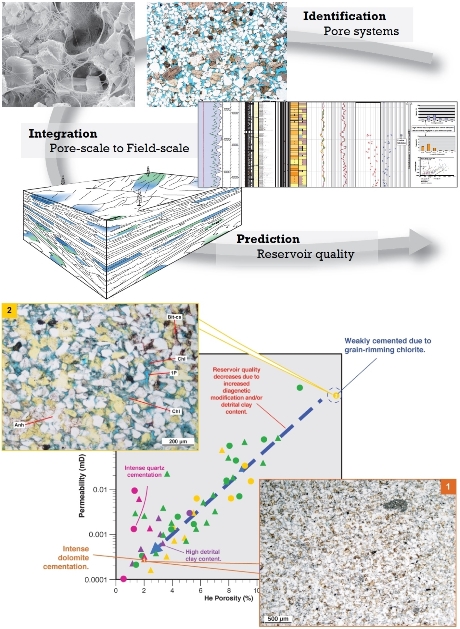
This one-day awareness course is designed to help attendees to understand every geological aspect of the decision trees involved in clastic reservoir pore system analysis. The course covers the controls on pore system evolution from deposition to present day, contrasting the roles of depositional attributes and diagenetic processes, with a special emphasis on predictability. Pore system degradation pathways will be discussed and visualised with the help of representative diagrams and photomicrographs. The final session will provide further opportunity for re-enforcing the understanding with a series of case studies.
Session 1: Reservoir quality analysis – what it is and how to approach it?
• What is reservoir quality analysis?
• Introduction to clastic rock pore systems
• What controls the reservoir quality of clastic systems?
• Commonly used analytical tools and new developments
• Work flow and decision trees
Sessions 2-3: Controls on Reservoir Quality – from deposition to present day
• Depositional controls on reservoir quality
– depositional environment and reservoir quality
– texture and fabric; their influence on porosity and permeability
– matrix, pseudomatrix and organic matter
– effects of detrital composition on early diagenesis and compaction
• Burial and compaction
– mechanical and chemical compaction
– what to learn from compaction analysis?
• Early diagenetic processes
– environmental control on early burial geochemistry
– early cement phases
• Burial diagenesis: cementation and dissolution
– authigenic mineralogy; common cement phases and grain replacements
– secondary porosity formation by dissolution
– hydrocarbon charge and its effects on diagenesis
• Pore system evolution and the predictability of porosity degradation
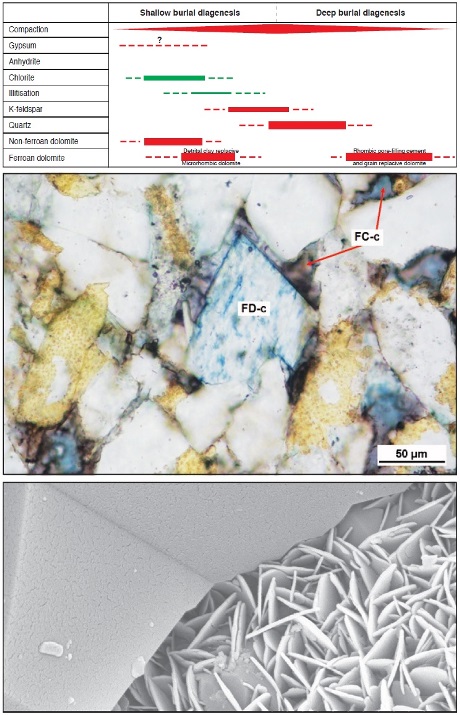
Participants
The course is targeted at geoscientists, petrophysicists and engineers with a mutual interest in pore-scale reservoir quality prediction in siliciclastic plays.
Badley Ashton Reservoir Quality Course Flier
Instructors
Badley Ashton’s clastic reservoir geologists have a keen interest in sedimentology and petrography with established experience in the across the globe. Our geologists currently work on single-well and multiwell reservoir quality evaluation studies. These projects cover a wide range of depositional environments from aeolian to deep water reservoirs. The instructors have a combination of industrial, research and teaching experience.
If you would like more information on this, or any other courses, please e-mail training@badley-ashton.co.uk or call +44 (0) 1507 588353.