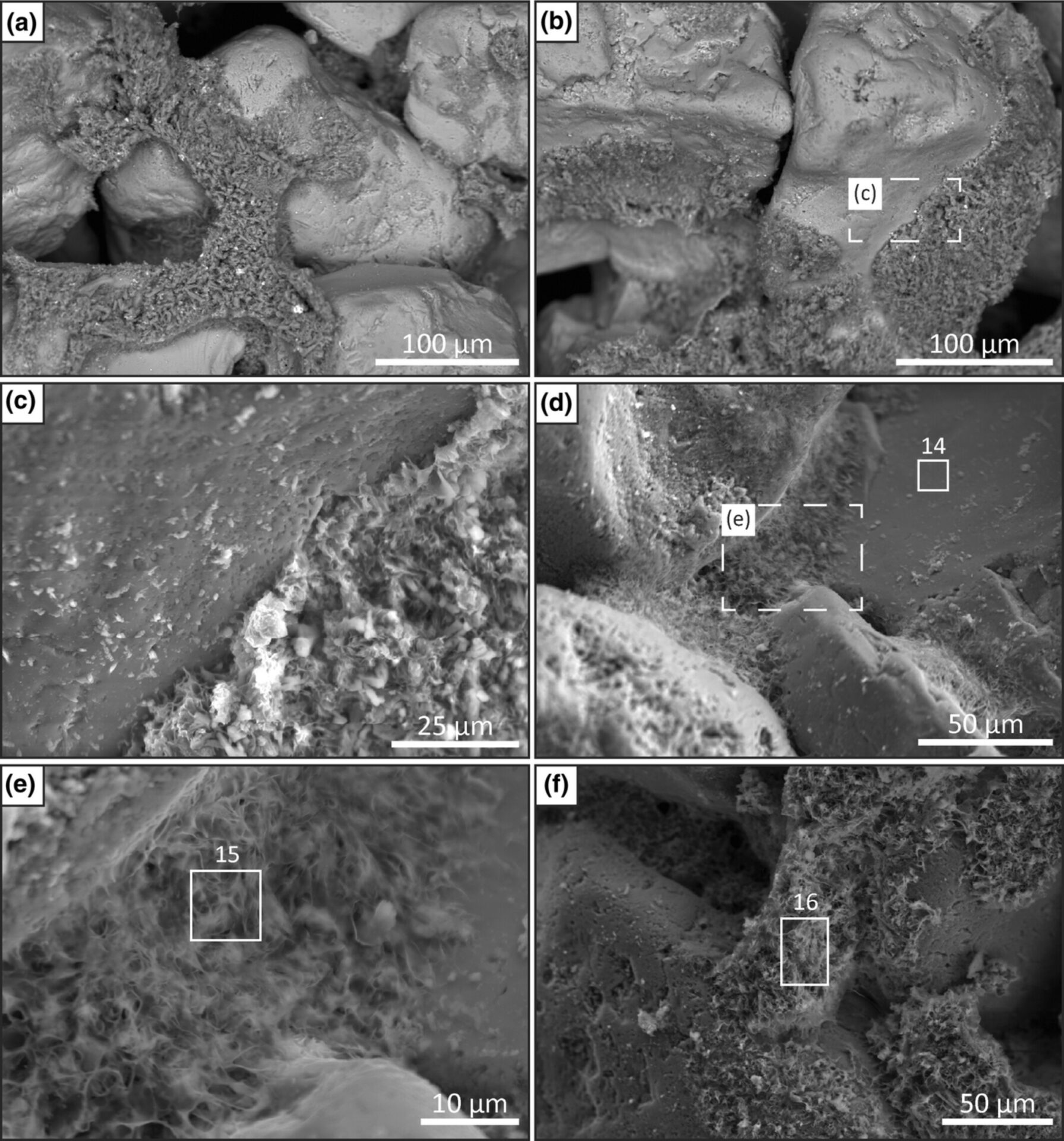
Bacteria are the most abundant forms of life we know on our planet, able to survive in a variety of habitats, that play an important role in mineral formation and transformation processes. Here, we present laboratory experiments in which unconsolidated quartz grains were seeded with Geobacter sulfurreducens cells and exposed to a mineral medium solution for 96 hours at temperatures of between 60°C and 120°C. Experimental data show the interdependence between extracellular polymeric substances (EPS) and the early formation of grain-coating material. The occurrence of EPS promotes the development of web and bridging structures binding the quartz grains and creating EPS-coated surfaces. With increasing temperature, an amorphous mineral phase grows preferentially on these surfaces suggesting that EPS can act as a template for mineral nucleation. At temperatures >100°C, the order of crystallinity of the amorphous authigenic phase increases, transitioning to poorly-ordered rosette-like textures.
Charlaftis, D., Jones, S.J., Grimm, L. & Kappler, A. 2023. Interdependence between bacterial EPS and early grain coat development. Terra Nova, 00, 1– 9, doi.org/10.1111/ter.12648.